The Comparison: Acupuncture vs. Dry Needling
Acupuncture VS Dry Needling
Acupuncture VS Dry Needling
Acupuncture VS Dry Needling
Acupuncture VS Dry Needling
Acupuncture VS Dry Needling
THERE IS A SPECIAL BONUS ROAST COMPAIRING ACUPUNCTURE VS DRY NEEDLING AT THE BOTTOM OF THIS PAGE
While both practices use thin filiform needles, they are worlds apart in training, philosophy, and safety. Below is a breakdown comparing the ancient art of acupuncture to its modern, more “aggressive” cousin.
- Philosophical Roots:
- Acupuncture: An ancient Chinese medical system (over 2,500 years old) that balances the body’s “Qi” (energy) along meridians to treat whole-body health.
- Dry Needling: A 20th-century Western adaptation that targets “trigger points” (muscle knots) to relieve local musculoskeletal pain.
- Practitioner Training:
- Acupuncture: Licensed acupuncturists typically complete a Master’s degree and 3,000+ hours of specialized training, including national board exams.
- Dry Needling: Often performed by physical therapists who may have as little as 24 to 72 hours of needle-specific training from weekend courses.
- Technique & Sensation:
- Acupuncture: Uses thinner needles inserted superficially; patients often find it relaxing and may even fall asleep.
- Dry Needling: Often involves “pistoning” (moving the needle in and out rapidly) to provoke a muscle twitch, which can be significantly more painful and leave patients sore for 24–48 hours.
- Safety Profile:
- Acupuncture: Boasts an excellent safety record due to extensive anatomical training and gentler methods.
- Dry Needling: Carries a higher risk of adverse events like pneumothorax (collapsed lung), nerve damage, and significant bruising due to deeper, more aggressive manipulation by practitioners with less needle-specific education.
While acupuncture is generally safe when performed by experts, the “aggressive” nature of dry needling and the lower training requirements for some practitioners lead to a distinct risk profile.
The Risks: Dry Needling vs. Acupuncture
- Pneumothorax (Collapsed Lung):
- Acupuncture Safety: Extremely rare. A study of 2.2 million treatments found only two cases (roughly 0.0001%).
- Dry Needling Pneumothorax: Carries a higher relative risk when needling near the chest or upper back. One analysis showed dry needling was responsible for 2 out of 3 reported pneumothoraces in a long-term study despite being performed less frequently than traditional acupuncture.
- Minor Adverse Events:
- Acupuncture: Minor reactions (bruising/bleeding) occur in roughly 7.5% of treatments.
- Dry Needling: Much more common. One large survey of physical therapists found minor adverse events in 36.7% of sessions, meaning roughly 1 in 3 treatments results in bleeding, bruising, or pain.
- Needle Manipulation & Pain:
- Acupuncture: Typically superficial and stationary; many patients report falling asleep.
- Dry Needling: Often involves “pistoning” (rapidly moving the needle in and out) to force a muscle twitch. This is deliberately aggressive and frequently causes significant soreness for 24–48 hours.
- Serious Complications:
- Acupuncture: Serious adverse events are “extremely low,” occurring at a rate of about 8 per one million treatments.
- Dry Needling: While still rare (<0.1%), major events like nerve damage, fainting, and excessive bleeding are more frequently linked to the lack of extensive anatomical needle training (often just a weekend course).
Risk Summary Table Acupuncture Vs Dry Needling
| Feature | Acupuncture (TCM) | Dry Needling (Western) |
|---|---|---|
| Common Side Effects | Mild bruising, relaxation | Significant soreness, twitching |
| Minor Event Rate | ~7.5% | ~36.7% |
| Serious Event Rate | ~0.0008% | ~0.1% (in some surveys) |
| Primary Danger | Rare infection | Pneumothorax, nerve trauma |
A pneumothorax (collapsed lung) is not just a “little air leak”—it is a major medical event that can lead to severe physiological damage and even death if the pressure isn’t relieved immediately.
The “Injury List”: Complications of Pneumothorax
- Tension Pneumothorax: This is the most dangerous “upgrade.” The injury acts as a one-way valve, letting air into the chest but not out. The resulting pressure can:
- Shift the Mediastinum: Literally push your heart, trachea, and major blood vessels to the other side of your chest.
- Compress the Heart: The pressure can squeeze the heart so tightly it can’t pump blood, leading to cardiovascular collapse.
- Hypoxia (Oxygen Deprivation): As the lung collapses, it can no longer exchange gas. This leads to dangerously low blood oxygen, causing cyanosis (bluish skin/lips) and potential organ damage from lack of oxygen.
- Secondary “Fluid” Injuries:
- Hemopneumothorax: When the trauma causes blood to pool in the chest cavity alongside the air.
- Pyopneumothorax / Empyema: The introduction of bacteria (often from a non-sterile needle) can cause pus to fill the pleural space, leading to severe infection.
- Pneumomediastinum: Air can leak into the center of the chest (the mediastinum), which may further travel into the neck and face, causing subcutaneous emphysema—a condition where air is trapped under the skin, making it crackle like Rice Krispies when touched.
- Re-expansion Pulmonary Edema: Ironically, after the lung is fixed, it can rapidly fill with fluid, causing a secondary type of respiratory distress as it tries to re-inflate.
- Cardiac and Respiratory Arrest: If the pressure isn’t relieved, the combined failure of the lungs and the heart leads to complete arrest
Treatment-Related “Bonus” Injuries
Because a dry-needler accidentally pokes you, you often have to undergo more invasive procedures to fix it:
- Tube Thoracostomy (Chest Tube): A thick tube is shoved between your ribs to drain the air.
- Neurovascular Bundle Damage: The emergency chest tube itself can accidentally damage the nerves and blood vessels that run along your ribs.
Because dry needling is often performed by practitioners with a fraction of the anatomical training that acupuncturists receive, it is critical to recognize when a “routine” session has turned into a medical emergency. Symptoms can appear immediately or be delayed by several hours.
Emergency Warning Signs: When to Seek Help
If you experience any of the following after a dry needling session, especially if the practitioner was working near your neck, shoulders, or rib cage, seek immediate medical attention.
1. Respiratory Emergency (Signs of Lung Collapse)
A pneumothorax is the most serious risk of thoracic dry needling. Watch for:
- Sudden, Sharp Chest Pain: Often feels stabbing and worsens specifically when you try to breathe in.
- Shortness of Breath: Sudden difficulty catching your breath or feeling like your breathing is “labored”.
- Cyanosis: A bluish tinge to your lips, skin, or fingernails, indicating your blood isn’t getting enough oxygen.
- Rapid Heart Rate & Breathing: Your body struggling to compensate for the collapsed lung.
- Dry Cough: A sudden, persistent cough that wasn’t there before the session
2. Nerve Injury Signs
While dry needling aims for a “twitch,” hitting a nerve is different:
- The “Zing”: An electric shock sensation or sharp zap that radiates down an arm or leg during the needle insertion.
- Persistent Numbness: Numbness or a “pins and needles” feeling that lasts longer than a few hours.
- Muscle Weakness: A sudden inability to move a limb normally or a feeling of “heaviness” that persists.
3. Infection & Systemic Shock
- Red Streaking: Red lines moving away from the needle site (a sign of serious infection).
- Fainting or Extreme Dizziness: While common in those with needle phobias, persistent lightheadedness can signal a vasovagal response or, in severe cases, the onset of shock from a tension pneumothorax.
Acupuncture Safety
VS
Dry Needling Pneumothorax
Acupuncture VS Dry Needling
Acupuncture VS Dry Needling
Acupuncture VS Dry Needling
Acupuncture VS Dry Needling
Acupuncture VS Dry Needling
The “Is This Normal?” Checklist
| Sensation | Normal (The “Good” Pain) | Abnormal (The “Run to the ER” Pain) |
|---|---|---|
| Duration | Dull ache for 24–48 hours | Pain that worsens after 72 hours |
| Breathing | No change | Pain when inhaling or shortness of breath |
| Sensation | Local muscle twitch | Electric shock or radiating numbness |
| Site Appearance | Pinpoint bruise | Increasing redness, heat, or pus |
Please copy and paste the letter below to send to you governmental representation
Take Action: Support Patient Safety in Dry Needling
Subject: Urgent: Support Enhanced Training Standards for Dry Needling in Florida
Dear Representative/Senator [Lawmaker’s Last Name],
As a resident of your district and a concerned advocate for healthcare safety, I am writing to urge you to introduce or support legislation that establishes rigorous continuing education requirements for healthcare providers performing “dry needling.”
While dry needling is becoming more common, it is an invasive procedure involving the insertion of filiform needles into muscular tissue. When performed without sufficient, ongoing training, it poses a significant risk of injury to the public.
To ensure the highest standard of care, I am requesting a legislative update that would require any healthcare practitioner authorized to perform dry needling to:
- Complete 30–50 hours of specialized, hands-on training every two years.
- Maintain these hours in addition to the standard continuing education units required for their primary medical license.
Techniques and safety protocols in needle-based therapies are constantly evolving. A “one-and-done” certification is not enough to guarantee that a practitioner is up-to-date on the latest safety standards, anatomical considerations, and infection control measures. By requiring biennial recertification, Florida can lead the way in protecting patients from avoidable harm.
Our community deserves to know that when a practitioner uses a needle, they are held to a standard of mastery, not just a minimum requirement.
I look forward to hearing your position on this vital public safety issue.
Sincerely,
[Your Name] [Your Address] [Your Phone Number/Email]
This initiative is part of your commitment to elevating the standards of natural and traditional medicine in the region.
Acupuncture VS Dry Needling
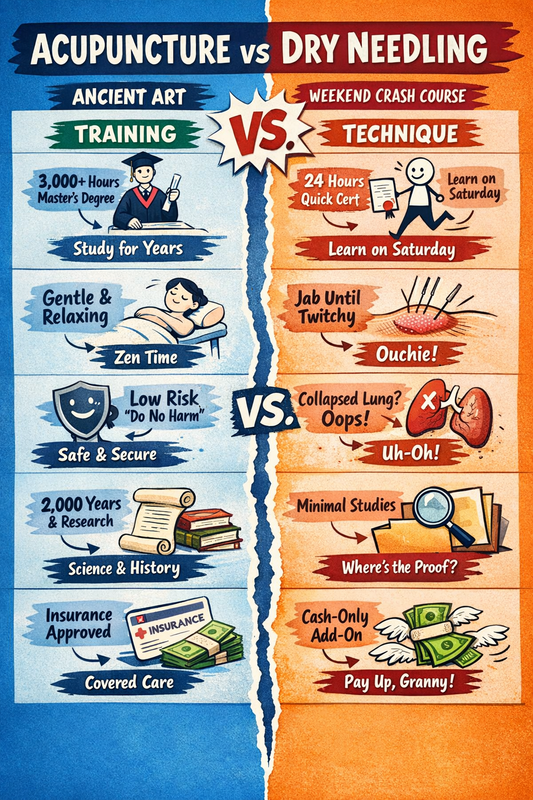
Why Dry Needling is the “Fast Fashion” of Medicine
(A light hearted opinion section filled with great points)
- The “Weekend Warrior” Certificate: Imagine if your surgeon learned to operate via a two-day seminar in a hotel ballroom. That is the training gap. Acupuncturists spend years mastering the anatomy of 365+ points and Licensed acupuncturists spend 3,000+ hours mastering the delicate art of not puncturing your internal organs. Meanwhile, some dry needlers get their “certification” in the time it takes to binge-watch a Netflix series. many dry needlers just aim for the “knot” and hope they don’t hit a lung. If you want your healthcare delivered by someone whose qualification is basically a participation trophy from a hotel ballroom seminar, dry needling is for you.
- It’s Just “Acupuncture Lite”: The Florida Board of Acupuncture and other experts argue that dry needling is essentially unlicensed acupuncture rebranded with Western terminology to bypass strict medical regulations. It’s the “sparkling wine” to acupuncture’s “Champagne.”
- The “Meat Tenderizer” Approach: While acupuncture seeks to harmonize your entire nervous system, dry needling often treats your muscles like a piece of steak that needs aggressive “pistoning” to tenderize. If you enjoy feeling like you’ve been poked with a toothpick by an over-caffeinated woodpecker, dry needling is for you.
- A Lack of Evidence: While acupuncture has thousands of years of clinical history and robust modern research for systemic issues, high-quality evidence for the long-term effectiveness of dry needling remains “paucity” at best, with some studies questioning if trigger points can even be reliably identified by hand.
- The Branding Scam of the Century: Dry needling is essentially acupuncture that went to a two-day corporate retreat and came back with a LinkedIn profile. Practitioners will look you in the eye and say, “This isn’t acupuncture,” while holding a literal acupuncture needle. It’s like a person holding a taco and insisting it’s a “hand-held corn-shell protein delivery system” because they didn’t go to culinary school in Mexico.
- The “Aggressive Poking” Methodology: Acupuncture is a symphony; dry needling is a toddler with a drum kit. While an acupuncturist gently balances your system, a dry needler is “pistoning”—which is medical speak for “stabbing your muscle until it gives up”. They call the resulting muscle spasm a “therapeutic twitch response”; the rest of us call it a “biological scream for help.”
- “It’s Not Magic, It’s Science” (Except for the Parts We Don’t Know): Dry needlers love to claim they are “evidence-based,” yet some major studies show low-quality evidence that it’s any better than a placebo or just a good old-fashioned massage. They’ve taken one single technique out of the 2,500-year-old acupuncture toolkit, stripped away the safety and philosophy, and sold it back to you as a “modern medical breakthrough”.
- The Insurance Ghost: Even the insurance companies aren’t buying the hype. While acupuncture is increasingly covered by major providers for various conditions, dry needling is often a cash-only “wellness” add-on. Even the bean-counters know the difference between a medical system and a “poking hobby.”
Acupuncture VS Dry Needling

Sunshine Wellness Clinic INC treatment is available to all regardless of race, creed, gender, economic status, sexual orientation.

Call now to see if you are covered! (772) 453-1072 We accept many insurances including Blue Cross Blue Shield, Optum Care Network, Medicaid Florida, WellCare Health Plans, Humana Care plan, Sunshine State Health Plan, United Healthcare, Cigna, American Specialty Health Networks, Medrisk and Many More
Acupuncture VS Dry Needling
Acupuncture VS Dry Needling
Acupuncture VS Dry Needling
Acupuncture VS Dry Needling
Acupuncture VS Dry Needling
Acupuncture Safety
VS
Dry Needling Pneumothorax
Research and safety information summarized from peer-reviewed journals and resources including the National Institutes of Health, the World Health Organization, and PubMed indexed studies.
EXTERNAL LINKS
Bibliography
Acupuncture vs Dry Needling Safety, Training, and Research
Major Research & Safety Reviews
- National Center for Complementary and Integrative Health.
Acupuncture: In Depth.
U.S. National Institutes of Health.
https://www.nccih.nih.gov/health/acupuncture-in-depth - World Health Organization.
WHO Traditional Medicine Strategy 2014–2023.
Geneva: World Health Organization. - National Institutes of Health.
NIH Consensus Statement: Acupuncture.
NIH Office of Medical Applications of Research.
Acupuncture Safety Studies
- MacPherson H., et al. (2001).
York Acupuncture Safety Study: Prospective Survey of 34,000 Treatments by Traditional Acupuncturists.
BMJ (British Medical Journal). - Witt C., et al. (2009).
Safety of Acupuncture: Results of a Prospective Observational Study with 229,230 Patients and 2.2 Million Treatments.
Archives of Internal Medicine. - White A., et al. (2004).
Adverse Events Following Acupuncture: Prospective Survey of 32,000 Consultations.
BMJ.
Dry Needling Safety & Adverse Events
- Brady S., et al. (2014).
Adverse Events Following Trigger Point Dry Needling: A Prospective Survey of Chartered Physiotherapists.
Journal of Manual & Manipulative Therapy. - Boyce D., et al. (2020).
Adverse Events Associated with Therapeutic Dry Needling.
International Journal of Sports Physical Therapy.
Pneumothorax and Needling Complications
- Peuker E., Gronemeyer D. (2001).
Rare but Serious Complications of Acupuncture: Traumatic Pneumothorax and Cardiac Tamponade.
Anesthesia & Analgesia. - Kim D.C., et al. (2014).
Pneumothorax Following Dry Needling: Case Report.
Journal of Orthopaedic & Sports Physical Therapy. - PubMed
Database of biomedical literature documenting case reports and safety studies related to acupuncture and dry needling.
Trigger Point and Dry Needling Research
- Dunning J., et al. (2014).
Dry Needling: A Literature Review with Implications for Clinical Practice Guidelines.
Physical Therapy Reviews. - Tough E.A., et al. (2007).
Variability of Criteria Used to Diagnose Myofascial Trigger Point Pain Syndrome.
Journal of Musculoskeletal Pain.
Training and Professional Standards
- National Certification Commission for Acupuncture and Oriental Medicine.
Education and Certification Standards for Licensed Acupuncturists. - Florida Board of Acupuncture.
Licensing Requirements for Acupuncturists in Florida.
Acupuncture VS Dry Needling
Acupuncture VS Dry Needling
Acupuncture VS Dry Needling
Acupuncture VS Dry Needling
Acupuncture VS Dry Needling
Acupuncture Safety
VS
Dry Needling Pneumothorax